
Voluntary sustainability reporting
There are various ways to report voluntarily, for example through established international frameworks such as VSME and the UN's 17 global goals for sustainable development.
VSME (Voluntary Sustainability Reporting Standard for non-listed SMEs) is specifically designed for smaller, unlisted companies and is the framework recommended by the European Commission for all companies that are not covered by the CSRD. It provides structured but proportionate support for reporting the most essential parts of sustainability work. Agenda 2030 and the UN's 17 global goals for sustainable development can also be used to clarify how your business contributes to, for example, climate action, gender equality or sustainable supply chains. It gives your sustainability work a clear direction and strengthens your position in a larger societal context.
To make sustainability reporting both concrete and effective, we offer PureAct – a digital management system that supports companies in working in a structured way with sustainability issues. The system is comprehensive with several functions for strategic sustainability work and reporting. There, you can, among other things, prepare a voluntary sustainability report, either according to VSME or in relation to the UN's 17 global goals.
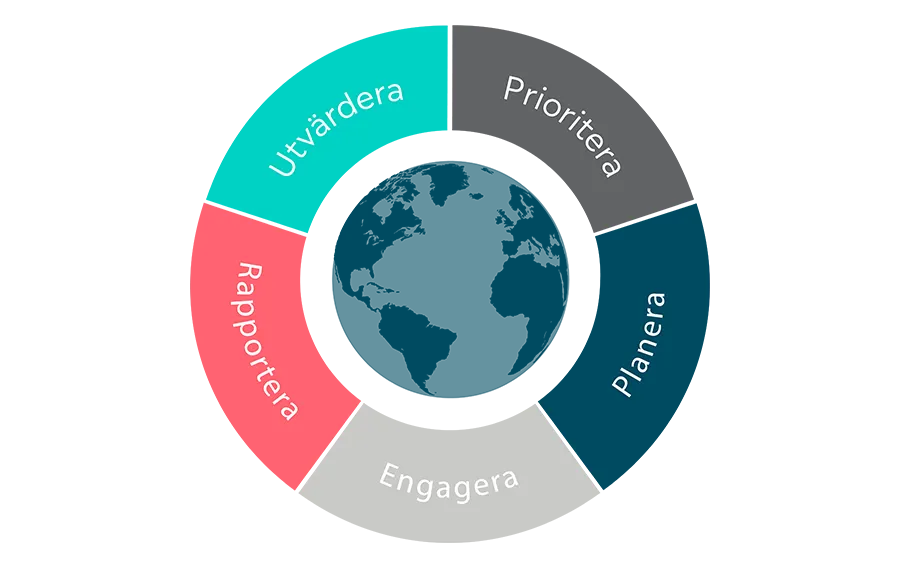
Sustainability reporting with our management system PureAct and qualified ESG advice
PureAct is a management system that structures and streamlines sustainability work and voluntary sustainability reporting. Gather activities, metrics and policies in one place – and follow the development over time, and the scope of your reporting can be adapted to your level of ambition.

We adapt to your needs
Whether you are facing your first sustainability report, need to update existing processes or want to take a first voluntary step – we are here to support.
We help you choose the right path, set up structures, formulate goals and produce reports that create both compliance and business value
Statutory sustainability reporting
The EU's directive, CSRD (Corporate Sustainability Reporting Directive), means that significantly more companies need to report on sustainability according to more detailed requirements. The financial statements must be integrated into the annual accounts and comply with the European Reporting Standards (ESRS). This places new demands on both data collection, governance and risk assessment.
Here we support you from start to finish, in a way that suits your organization. Our experts have broad expertise in double materiality analysis, gap analysis, action plans, reporting and the EU taxonomy for environmentally sustainable economic activities.
Regulations and concepts
Learn more about relevant sustainability concepts and which regulations are important to be aware of.
-
CSRD is the EU’s framework for sustainability reporting, replacing the previous directive (NFRD) in the Accounting Act. It tightens requirements for companies to report on their sustainability efforts according to common European standards (ESRS), with the aim of increasing transparency, improving data quality and making sustainability information comparable - just like financial reporting.
The legislation is constantly evolving and an increasing number of companies are affected both directly and indirectly. Requirements to report on environmental, social and governance (ESG) issues are becoming more detailed and comprehensive, making it essential to understand, plan and structure sustainability work early to meet new demands from both regulators and stakeholders.
-
The Taxonomy is both an EU regulation and a classification system that defines which economic activities are considered environmentally sustainable. For larger companies, it is mandatory to identify, analyse and report the share of their activities that meet the Taxonomy’s criteria. Companies subject to the CSRD must also include Taxonomy reporting in their sustainability disclosures.
-
CSDDD is an EU legal requirement that obliges companies to identify, prevent and address negative impacts on people, the environment and society throughout their value chain. The purpose is to strengthen responsibility for sustainability and human rights across the entire supply chain.
-
VSME is a reporting framework for companies not covered by the CSRD. The standard enables structured, transparent and proportionate reporting without requiring compliance with the same obligations as large companies.
Companies not yet subject to legal requirements can gain significant benefits from voluntarily reporting their sustainability work. It demonstrates transparency, strengthens the brand and prepares the organisation for future regulatory demands. By using established frameworks like VSME, reporting can be both structured and credible.
-
ESRS are the standards that define how companies must report under the CSRD. They include both cross-sector and sector-specific requirements, focusing on environmental, social and governance aspects. The standards serve as a common framework to ensure comparable, reliable and transparent sustainability information across the EU.
-
GRI is one of the world’s most widely used frameworks for sustainability reporting. It helps companies systematically report on key sustainability issues whether reporting is voluntary or legally required. GRI standards are user-friendly, well-established and compatible with other regulatory frameworks.
-
The Global Goals, adopted by UN member states, form a shared agenda to create a sustainable world by 2030. The goals cover everything from climate, environment and energy to education, equality and health and can serve as guidelines for companies seeking to contribute to societal development through their sustainability efforts.
Agenda 2030 is the UN’s overarching action plan for sustainable development and provides the framework for the 17 Global Goals. Its aim is to create a more just, sustainable and inclusive society both globally and locally. Companies can use the goals to clarify their impact, take responsibility across the value chain and connect their efforts to a broader context.
-
Science Based Targets are climate goals aligned with what science indicates is necessary to meet the Paris Agreement. The Paris Agreement is a global accord aimed at limiting global warming to well below 2°C (preferably below 1.5°C) compared to pre-industrial levels.
Companies that commit to SBTi undertake to set clear targets to reduce their emissions in line with what is required to limit global warming to 1.5°C.
-
A double materiality assessment is a requirement under CSRD and involves identifying a company’s most important sustainability issues by mapping both how the company impacts people, the environment and society (impact materiality) and which sustainability issues are financially material to the business (financial materiality). The assessment forms the foundation for a relevant and credible sustainability report.
-
When companies measure their greenhouse gas emissions, they are divided into three categories, or scopes, according to the GHG Protocol:
Scope 1 – Direct emissions from the company’s own operations, such as from company-owned vehicles or combustion facilities.
Scope 2 – Indirect emissions from purchased energy, such as electricity, district heating and steam.
Scope 3 – Other indirect emissions in the value chain, both upstream (e.g., purchased goods and materials, transportation and business travel) and downstream (e.g., use of sold products, waste management, or investments). Scope 3 is often the largest and most challenging to measure and influence. At the same time, it is crucial for obtaining a complete picture of the company’s climate impact and setting relevant climate targets.
-
Climate neutrality means that a company has net zero greenhouse gas emissions, often achieved by reducing emissions as much as possible and offsetting the remaining impact. It is an increasingly common requirement from both investors and customers and is often a clear objective in companies’ climate strategies.
-
Taking responsibility for sustainability in the supply chain is becoming increasingly important. Companies are expected to have insight into and influence over, how their suppliers act regarding working conditions, environmental impact and human rights. Supplier audits, codes of conduct and contracts are examples of tools to achieve this.
Contact us
Don't hesitate to leave your contact details – we'll get back to you as soon as we can.